
Content taken from pages 67-69 of The Politics of Breastfeeding: When Breasts are Bad for Business
In the 1860s, a German chemist, Justus von Liebig* (1803-1873) often called ‘the father of modern nutrition’ invented the perfect infant food’. It was made of wheat flour, cows’ milk, malt flour and bicarbonate of potash. Though patented, commercialised and delivered in liquid form, it did not sell well. A powdered form was then developed with some of the cows’ milk replaced with pea flour. To von Liebig’s annoyance, some doctors claimed it was indigestible and did not match human milk, but one of his devotees argued:
“If we were to say that this preparation does not agree with newborn babies, such a statement could not be supported on theoretical grounds, since in the food they get the very same ingredients as in mother’s milk. As therefore this milk agrees with them I cannot understand why they should be unable to digest Liebig’s Food.”
Artificial milk has been a hit and miss affair, relying on experimentation on babies. Its composition has been as much influenced by nutritional fashion as by facts, as both the Syntex story in Chapter 15 and the ‘novel oils’ account below, illustrate. Artificial milk is an entirely different substance from human milk, containing no living cells and not adapting to each baby’s individual and changing needs.
I compare breastmilk with cows’ milk, the commonest basis of breastmilk substitutes, not because it is the most appropriate substance – chimpanzees’ or horses’ milk might be better – but because it has been the most available and therefore the most used.**
As a marketing report states: “The choice of ingredient used to supply the proteins to infant formulae will depend on two main factors, the price and the carbohydrate used in the formula”. It then explains that the carbohydrate maltodextrin (which sounds so delightfully scientific) is derived from maize with potatoes as secondary source.
As you read on, you may be amazed to realise that a product presented as ‘closest to mother’s milk’ might actually include potatoes, fungi and beans, depending on the price of course.
By the 1960s, due to both nutritional fashion and economic expediency, artificial milk manufacturers tended to replace most or all of the butterfat in cows’ milk. Coconut, palm and other vegetable oils were used because they were cheap as was beef tallow, a waste product from the meat industry. So was groundnut oil which might trigger peanut allergy or contain traces of cancer-causing aflatoxins. Agro-chemicals are used in most large-scale oil crop production and replace breastmilk fats which help the brain and nervous system to develop, so marine oils came into favour, but there was the risk of environmental pollutants and the marketing impediment that mothers (and some babies) disliked the fishy taste.
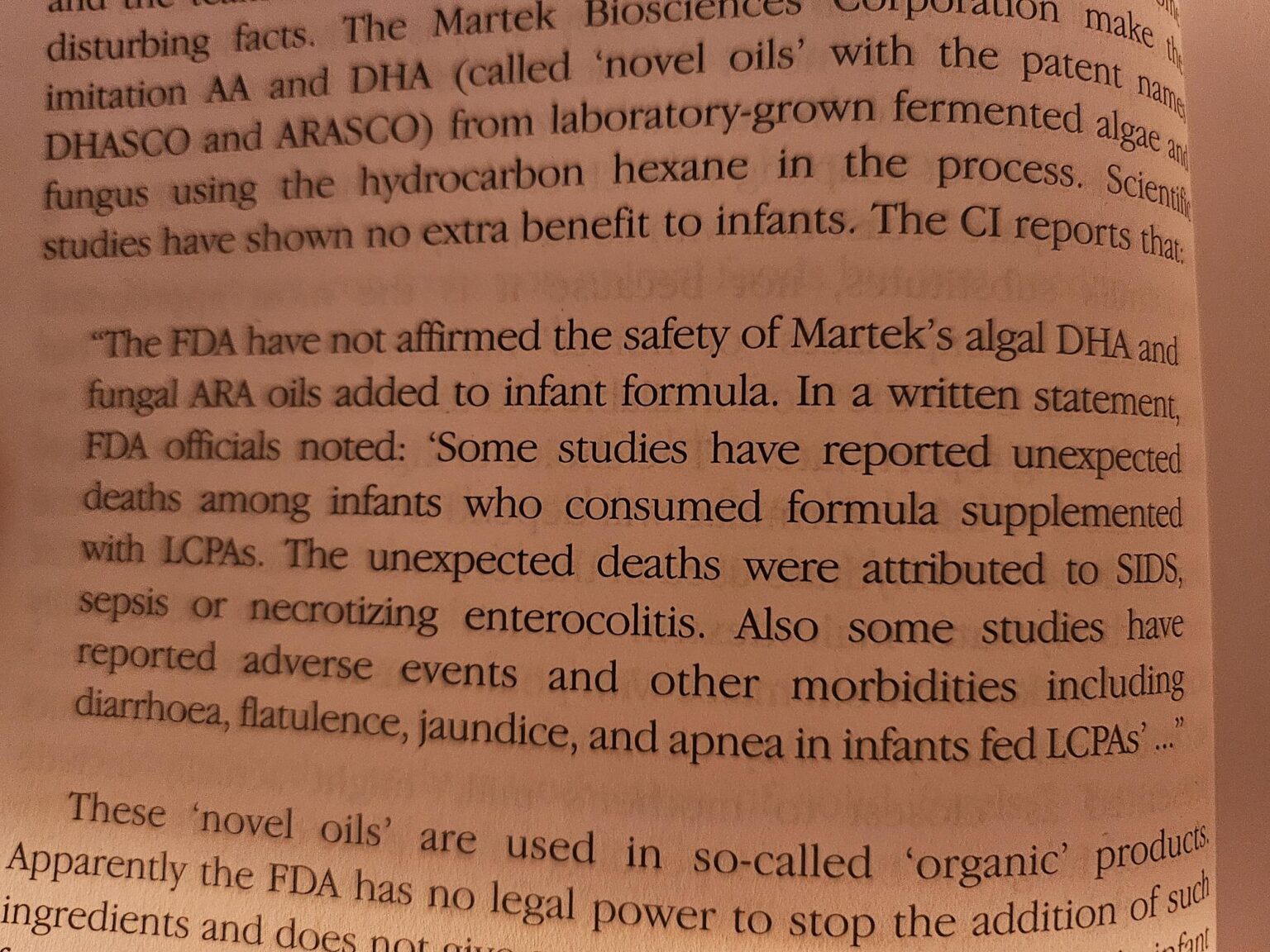
Since 2002 some companies have been trying to imitate certain important fats in breastmilk (please do not be put off by their long names), notably long-chain polyunsaturated fatty acids (LCPAs) called arachidonic acid (shortened to either AA or ARA) and docasahexanoic acid (DHA) which are crucial for brain, nerve and eye development. They are one reason for breastfed babies’ better brains, eyes and general development. You might think how kind the companies are who add these products to artificial milks. However, Charlotte Vallaeys and the team at Cornucopia Institute (CI) have gathered some disturbing facts. The Martek Biosciences Corporation make the imitation AA and DHA (called ‘novel oils’ with the patent names DHASCO and ARASCO) from laboratory-grown fermented algae and fungus using the hydrocarbon hexane in the process. Scientific studies have shown no extra benefit to infants. The CI reports that:
“The FDA have not affirmed the safety of Martek’s algal DHA and fungal ARA oils added to infant formula. In a written statement, FDA official noted: ‘Some studies have reported unexpected deaths among infants who consumed formula supplemented with LCPAs. The unexpected deaths were attributed to SIDS, sepsis or necrotizing enterocolitis. Also some studies have reported adverse events and other morbidities including diarrhoea, flatulence, jaundice, and apnea in infants fed LCPAs’…”
These ‘novel oils’ are used in so called ‘organic’ products.
Apparently the FDA has no legal power to stop the addition of such ingredients and does not give approval for novel ingredients in infant formula. The FDA can only raise questions when a company requests for an ingredient to be given the status of “Generally recognised as safe’ or “GRAS”. The FDA has told the manufacturers that they must perform rigorous in-market surveillance. Meanwhile the artificial milks containing these novel oils are aggressively advertised as having a beneficial effect on infant brain and eye development. But then as a Martek investment promotion explained in 1996: “Even if [the DHA/ARA blend] has no benefit, we think it would be widely incorporated into formulas, as a marketing tool and to allow companies to promote their formula as ‘closest to human milk.'”
The European Food Safety Authority (EFSA) has to deal with thousands of companies submitting applications for health claims. Martek claimed about a follow-on milk that “DHA and ARA support neural development of the brain and eyes.” EFSA said that Martek failed to demonstrate causality and were denied permission to use this claim.