Even before I had given birth, I was told that I would have to give my baby formula because I would have an insufficient milk supply. This was from a mother who hadn’t even breastfed, and she was going off the story that her granddaughter had been breastfed, but her mother had an insufficient milk supply. That might have happened in her case, but was she feeding the baby in the night frequently etc, as the more babies suckle, the more milk they produce.
Lack of Professional Help
I wanted to succeed with breastfeeding, but it was all new to me. I wasn’t given the right information by the NHS, but I didn’t give up. It was difficult to breastfeed for two weeks; I just couldn’t help Grace to latch, so I would pump every few hours, and it came to a head the day when we took Grace to see a tongue tie specialist. Turns out her tongue was fine, but this bitch specialist who was supposed to be a lactation specialist too, told me that Grace was used to the bottle. She didn’t even try to help Grace to latch. All she was bothered about was getting us out of the room before the hour was up, and this was a private £75 consultation. She was absolutely fake with her compassion and hugs, and if you want to avoid making the same mistake we did, avoid her. She is called Pippa Middleton.
Yay, We Succeeded
I was absolutely devastated. The more I tried to breastfeed Grace, the more she would arch her back and not latch. I was inconsolable. My family did not understand, just kept telling me “well she needs to eat”. My husband was amazing, and still is with his support, and was never breastfed as a child. He would feed her my milk, and shortly after he came into the bedroom, he said “she still seems hungry. Try to put her on the boob”. Weirdly, she latched on and we have been breastfeeding ever since and she’s now 32 months. She loves breastfeeding, and I love feeding her. I feed her in public regularly. I am no longer shy, and I’ve never had any bad reaction from anyone.
Prior to our success, I was planning to make the raw milk formula recipe from Weston A Price Foundation, however, it was difficult to get a few of the ingredients, especially the gelatin, which was apparently an illegal substance to import and it was confiscated. I bet these scumbags have one big party on Fridays with the items they steal from people, because it is stealing. It’s not like it was a live bloody lizard, just a high quality gelatin.
No Formula Needed
I exclusively breastfed her for six months before adding solids, and I never topped her up with formula. It was not necessary. I was producing enough milk via the principle of supply and demand, as I was feeding her every three or four hours and I never timed the feeds. She would often feed on the left, but I could latch her onto the right nipple in the middle of the night while she was half asleep and she would drain it. The breasts are so amazing in how they feed a child. Absolutely amazing. I’m still amazed at the power my little daughter has in producing her own milk supply.
Of course mothers can provide enough milk to feed their baby(ies) without the need to top up with formula, and one of the reasons why a mother gets an insufficient milk supply is because of the formula market. It’s absolute junk food compared to the raw superfood called breastmilk. I put in the work with Grace and it paid off, and I never had sore nipples either!
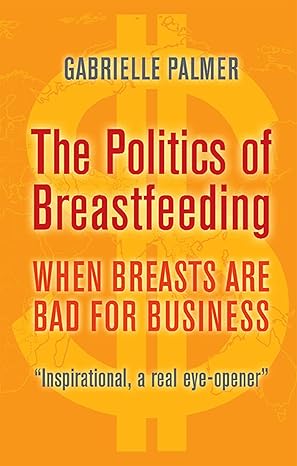
I found an excellent book in the charity shop called The Politics of Breastfeeding: When Breasts are Bad for Business. Did you know that the lie of insufficient milk supply came from the formula industry.
So I just wanted to type out this paragraph from pages 25 and 26 of The Politics of Breastfeeding.
Too much or too little
Cadogen and others’ ideas about the dangers of overfeeding persisted well into the 20th century. As more and more women became subject to orthodox health information, they were instructed to limit feeding time. Extra artificial feeds would be given to ‘top up’ the baby, thus satiated he would lose his appetite for the breast and the breastmilk supply would go down. Underfeeding was dreaded, but no less than overfeeding. Test weighing of the baby before and after a single breastfeed meant that few mothers were producing the exact quantities that were judged correct.
The advice to restrict feeding certainly did prevent any ‘danger’ of overfeeding, for the psychological result was that women who fed only at prescribed intervals or removed the baby from each breast after an exact number of minutes, were unknowingly shutting down their milk making system. Their babies cried, some did not gain weight and these mothers believed that their bodies were intimately incapable of producing enough milk for their babies’ needs.
To this day ‘insufficient milk’ is the commonest reason that women give for abandoning breastfeeding. This is more common in societies where free access to the breast is socially deplored. Ironically, an idea that evolved from a fear of a non-existent problem (there has never been any good evidence showing the ill effects of too much breastfeeding) led to the establishment of a real problem.
The Good Baby
In many societies, a ‘good’ baby is still judged by the amount of time he sleeps or lies passively alone in a cot. A mother who wants to hold her baby most of the time is judged eccentric and often accursed of ‘spoiling’ him. The separation of a mother and her baby reduces the chances of establishing a harmony between their psychological rhythms. New research tells us that during the 20th century we were misled by medical and nutritional science into trying to make babies gain weight faster by giving them extra foods besides breastmilk. This practice is now implicated in the international obesity epidemic and linked with later chronic diseases.
There are now new preachers of the religion of restriction and routine. Their book sales show that theri message fulfils some need in (mostly western) parents, to make their babies conform to an externally prescribed pattern very early. Whem mothers are allowed and encouraged to be intuitive and responsive to their babies’ cues, the pair adapt to each other rapidly and the synergy of two lives can be established happily. A baby’s relationship with her mother is the primary experience of love. Does anyone fall in love with a schedule?